Saturday, 20 January 2018

Dynamic braking

Dynamic braking is the use of an electric traction motor as a generator when slowing a vehicle such as an electric or diesel-electriclocomotive. It is termed "rheostatic" if the generated electrical power is dissipated as heat in brake grid resistors, and "regenerative" if the power is returned to the supply line. Dynamic braking reduces wear on friction-based braking components, and regeneration lowers net energy consumption. Dynamic braking may also be used on railcars with multiple unitslight rail vehicleselectric trams, and electric and hybrid electric automobiles.

    Principle of operation

    When braking, the motor fields are connected across either the main traction generator (diesel-electric locomotive) or the supply (electric locomotive) and the motor armatures are connected across either the brake grids or supply line. The rolling locomotive wheels turn the motor armatures, and if the motor fields are now excited, the motors will act as generators.
    During dynamic braking, the traction motors, which are now acting as generators, are connected to the braking grids (large resistors), which put a large load on the electrical circuit. When a generator circuit is loaded down with resistance, it causes the generators to slow their rotation. By varying the amount of excitation in the traction motor fields and the amount of resistance imposed on the circuit by the resistor grids, the traction motors can be slowed down to a virtual stop (approximately 3-5 MPH).
    For permanent magnet motors, dynamic braking is easily achieved by shorting the motor terminals, thus bringing the motor to a fast abrupt stop. This method, however, dissipates all the energy as heat in the motor itself, and so cannot be used in anything other than low-power intermittent applications due to cooling limitations. It is not suitable for traction applications.

    Rheostatic braking

    The electrical energy produced by the motors is dissipated as heat by a bank of onboard resistors. Large cooling fans are necessary to protect the resistors from damage. Modern systems have thermal monitoring, so, if the temperature of the bank becomes excessive, it will be switched off, and the braking will revert to friction only.

    Regenerative braking

    In electrified systems the similar process of regenerative braking is employed whereby the current produced during braking is fed back into the power supply system for use by other traction units, instead of being wasted as heat. It is normal practice to incorporate both regenerative and rheostatic braking in electrified systems. If the power supply system is not "receptive", i.e. incapable of absorbing the current, the system will default to rheostatic mode in order to provide the braking effect.
    Yard locomotives with onboard energy storage systems which allow the recovery of some of this energy which would otherwise be wasted as heat are now available. The Green Goat model, for example, is being used by Canadian Pacific RailwayBNSF RailwayKansas City Southern Railway and Union Pacific Railroad.
    On modern passenger locomotives equipped with AC inverters pulling trains with sufficient Head End Power loads braking energy can be used to power the train's on board systems as a form of regenerative braking if the electrification system is not receptive or even if the track is not electrified to begin with. The HEP load on modern passenger trains is so great that some new electric locomotives such as the ALP-46 were designed without the traditional resistance grids.

    Blended braking

    Connex South EasternClass 466 EMU at Blackfriars station in 2006 fitted with dynamic blended braking
    Dynamic braking alone is insufficient to stop a locomotive, as its braking effect rapidly diminishes below about 10 to 12 miles per hour (16 to 19 km/h). Therefore, it is always used in conjunction with the regular air brake. This combined system is called blended brakingLi-ion batteries have also been used to store energy for use in bringing trains to a complete halt.[1]
    Although blended braking combines both dynamic and air braking, the resulting braking force is designed to be the same as what the air brakes on their own provide. This is achieved by maximizing the dynamic brake portion, and automatically regulating the air brake portion, as the main purpose of dynamic braking is to reduce the amount of air braking required. This conserves air, and minimizes the risks of over-heated wheels. One locomotive manufacturer, Electro-Motive Diesel (EMD), estimates that dynamic braking provides between 50% to 70% of the braking force during blended braking.

    Self-load test

    It is possible to use the brake grids as a form of dynamometer or load bank to perform a "self load" test of locomotive engine horsepower. With the locomotive stationary, the main generator (MG) output is connected to the grids instead of the traction motors. The grids are normally large enough to absorb the full engine output power, which is calculated from MG voltage and current output.

    Hydrodynamic braking

    Diesel engined locomotives with hydraulic transmission may be equipped for hydrodynamic braking. In this case, the torque converter or fluid coupling acts as a retarder in the same way as a water brake. Braking energy heats the hydraulic fluid, and the heat is dissipated (via a heat exchanger) by the engine cooling radiator. The engine will be idling (and producing little heat) during braking, so the radiator is not overloaded.

    electrical braking of a motor

    Dynamic braking is the use of an electric traction motor as a generator when slowing a vehicle such as an electric or diesel-electric locomotive. It is termed "rheostatic" if the generated electrical power is dissipated as heat in brake grid resistors, and "regenerative" if the power is returned to the supply line. Dynamic braking reduces wear on friction-based braking components, and regeneration lowers net energy consumption. Dynamic braking may also be used on railcars
    Principle of operation
    When braking, the motor fields are connected across either the main traction generator (diesel-electric locomotive) or the supply (electric locomotive) and the motor armatures are connected across either the brake grids or supply line. The rolling locomotive wheels turn the motor armatures, and if the motor fields are now excited, the motors will act as generators.
    During dynamic braking, the traction motors, which are now acting as generators, are connected to the braking grids (large resistors), which put a large load on the electrical circuit. When a generator circuit is loaded down with resistance, it causes the generators to slow their rotation. By varying the amount of excitation in the traction motor fields and the amount of resistance imposed on the circuit by the resistor grids, the traction motors can be slowed down to a virtual stop (approximately 3-5 MPH).
    For permanent magnet motors, dynamic braking is easily achieved by shorting the motor terminals, thus bringing the motor to a fast abrupt stop. This method, however, dissipates all the energy as heat in the motor itself, and so cannot be used in anything other than low-power intermittent applications due to cooling limitations. It is not suitable for traction applications.

    Wednesday, 17 January 2018

    Universal motor

    Universal motor 

    The universal motor is so named because it is a type of electric motor that can operate on AC or DC power. It is a commutated series-wound motor where the stator's field coils are connected in series with the rotor windings through a commutator. It is often referred to as an AC series motor. The universal motor is very similar to a DC series motor in construction, but is modified slightly to allow the motor to operate properly on AC power. This type of electric motor can operate well on AC because the current in both the field coils and the armature (and the resultant magnetic fields) will alternate (reverse polarity) synchronously with the supply. Hence the resulting mechanical force will occur in a consistent direction of rotation, independent of the direction of applied voltage, but determined by the commutator and polarity of the field coils.[1]
    Universal motors have high starting torque, can run at high speed, and are lightweight and compact. They are commonly used in portable power tools and equipment, as well as many household appliances. They're also relatively easy to control, electromechanically using tapped coils, or electronically. However, the commutator has brushes that wear, so they are much less often used for equipment that is in continuous use. In addition, partly because of the commutator, universal motors are typically very noisy, both acoustically and electromagnetically.[2]

      Properties

      Universal motors' field coils are series wound with the rotor coils and commutator
      Equivalent circuit
      Not all series wound motors operate well on AC current.[3][note 1] If an ordinary series wound DC motor were connected to an AC supply, it would run very poorly. The universal motor is modified in several ways to allow for proper AC supply operation. There is a compensating winding typically added, along with laminated pole pieces, as opposed to the solid pole pieces found in DC motors.[1] A universal motor's armature typically has far more coils and plates ta DC motor, and hence fewer windings per coil. This reduces the inductance.[4]

      Efficiency

      Even when used with AC power these types of motors are able to run at a rotation frequency well above that of the mains supply, and because most electric motor properties improve with speed, this means they can be lightweight and powerful.[4] However, universal motors are usually relatively inefficient: around 30% for smaller motors and up to 70-75% for larger ones.[4]

      Torque-speed characteristics

      Series wound electric motors respond to increased load by slowing down; the current increases and the torque rises in proportion to the square of the current since the same current flows in both the armature and the field windings. If the motor is stalled, the current is limited only by the total resistance of the windings and the torque can be very high, and there is a danger of the windings becoming overheated. The counter-EMF aids the armature resistance to limit the current through the armature. When power is first applied to a motor, the armature does not rotate. At that instant, the counter-EMF is zero and the only factor limiting the armature current is the armature resistance. Usually the armature resistance of a motor is low; therefore the current through the armature would be very large when the power is applied. Therefore the need can arise for an additional resistance in series with the armature to limit the current until the motor rotation can build up the counter-EMF. As the motor rotation builds up, the resistance is gradually cut out. The speed-torque characteristic is an almost perfectly straight line between the stall torque and the no-load speed. This suits large inertial loads as the speed will drop until the motor slowly starts to rotate and these motors have a very high stalling torque.[5]
      As the speed increases, the inductance of the rotor means that the ideal commutating point changes. Small motors typically have fixed commutation. While some larger universal motors have rotatable commutation, this is rare. Instead larger universal motors often have compensation windings in series with the motor, or sometimes inductively coupled, and placed at ninety electrical degrees to the main field axis. These reduce the reactance of the armature, and improve the commutation.[4]
      One useful property of having the field windings in series with the armature winding is that as the speed increases the counter EMF naturally reduces the voltage across, and current through the field windings, giving field weakening at high speeds. This means that the motor has no theoretical maximum speed for any particular applied voltage. Universal motors can be and are generally run at high speeds, 4000-16000 rpm, and can go over 20,000 rpm.[4] By way of contrast, AC synchronous and squirrel cage induction motors cannot turn a shaft faster than allowed by the power line frequency. In countries with 60 Hz(cycle/Sec) AC supply, this speed is limited to 3600 RPM.[6]
      Motor damage may occur from over-speeding (running at a rotational speed in excess of design limits) if the unit is operated with no significant mechanical load. On larger motors, sudden loss of load is to be avoided, and the possibility of such an occurrence is incorporated into the motor's protection and control schemes. In some smaller applications, a fan blade attached to the shaft often acts as an artificial load to limit the motor speed to a safe level, as well as a means to circulate cooling airflow over the armature and field windings. If there were no mechanical limits placed on a universal motor it could theoretically speed out of control in the same way any series-wound DC motor can.[2]
      An advantage of the universal motor is that AC supplies may be used on motors which have some characteristics more common in DC motors, specifically high starting torque and very compact design if high running speeds are used.[2]

      Disadvantages

      A negative aspect is the maintenance and short life problems caused by the commutator, as well as electromagnetic interference (EMI) issues due to any sparking. Because of the relatively high maintenance commutator brushes, universal motors are best-suited for devices such as food mixers and power tools which are used only intermittently, and often have high starting-torque demands.
      Another negative aspect is that these motors may only be used where mostly-clean air is present at all times. Due to the dramatically increased risk of overheating, totally-enclosed fan cooled universal motors would be impractical, though some have been made. Such a motor would need a large fan to circulate enough air, decreasing efficiency since the motor must use more energy to cool itself. The impracticality comes from the resulting size, weight, and thermal management issues which open motors have none of.

      Speed control

      Continuous speed control of a universal motor running on AC is easily obtained by use of a thyristor circuit, while multiple taps on the field coil provide (imprecise) stepped speed control. Household blenders that advertise many speeds frequently combine a field coil with several taps and a diode that can be inserted in series with the motor (causing the motor to run on half-wave rectified AC).

      Variations

      Shunt winding

      Universal motors are series wound. Shunt winding was used experimentally, in the late 19th century,[7] but was impractical owing to problems with commutation. Various schemes of embedded resistance, inductance and antiphase cross-coupling were attempted to reduce this. Universal motors, including shunt wound, were favoured as AC motors at this time as they were self-starting.[3] When self-starting induction motors and automatic starters became available, these replaced the larger universal motors (above 1 hp) and the shunt wound.

      Repulsion-start

      In the past, repulsion-start wound-rotor motors provided high starting torque, but with added complexity. Their rotors were similar to those of universal motors, but their brushes were connected only to each other. Transformer action induced current into the rotor. Brush position relative to field poles meant that starting torque was developed by rotor repulsion from the field poles. A centrifugal mechanism, when close to running speed, connected all commutator bars together to create the equivalent of a squirrel-cage rotor. As well, when close to operating speed, better motors lifted the brushes out of contact.

      Applications

      Domestic appliances

      Operating at normal power line frequencies, universal motors are often found in a range less than 1000 watts. Their high speed makes them useful for appliances such as blendersvacuum cleaners, and hair dryers where high speed and light weight are desirable. They are also commonly used in portable power tools, such as drillssanderscircular and jig saws, where the motor's characteristics work well. Many vacuum cleaner and weed trimmer motors exceed 10,000 RPM, while many Dremel and similar miniature grinders exceed 30,000 RPM.
      Universal motors also lend themselves to electronic speed control and, as such, were an ideal choice for domestic washing machines. The motor can be used to agitate the drum (both forwards and in reverse) by switching the field winding with respect to the armature. The motor can also be run up to the high speeds required for the spin cycle. Nowadays, variable-frequency drive motors are more commonly used instead.

      Rail traction

      Universal motors also formed the basis of the traditional railway traction motor in electric railways. In this application, the use of AC to power a motor originally designed to run on DC would lead to efficiency losses due to eddy current heating of their magnetic components, particularly the motor field pole-pieces that, for DC, would have used solid (un-laminated) iron. Although the heating effects are reduced by using laminated pole-pieces, as used for the cores of transformers and by the use of laminations of high permeability electrical steel, one solution available at the start of the 20th century was for the motors to be operated from very low frequency AC supplies, with 25 and 16 ​23 Hz operation being common.

      Starter motor

      Starters of combustion engines are usually universal motors, with the advantage of being small and having high torque at low speed. Some starters have permanent magnets, others have 1 out of the 4 poles wound with a shunt coil rather than series wound coils.

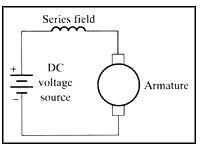
      DC Series Motor

      A DC series motor converts electrical energy to mechanical energy. Its principle of operation is based on a simple electromagnetic law that states that when a magnetic field is created around current carrying conductor and interacts with an external field, rotational motion is generated.
      • The key components of a DC series motor are the armature (rotor), stator, commutator, field windings, axle, and brushes. The stationary part of the DC Seies Motormotor, the stator is made up of two or more electromagnet pole pieces, and the rotor is comprised of the armature, with windings on the core connected to the commutator. The output power source is connected to the armature windings through a brush arrangement connected to the commutator. The rotor has a central axle about which the rotor rotates.
        The field winding should be able to support high current because the greater the amount of current through the winding, the greater will be the torque generated by the motor. So the winding of the motor is made up of thick heavy gauge wire. Heavy gauge wire does not allow a large number of turns. The winding is made up of thick copper bars as it helps in easy and efficient dissipation of heat generated as a result of flow of large amount of current through winding.
      • Principle of Operation

        An external voltage source is applied across the series configuration of field winding and armature. So one end of the voltage source is connected to the winding and the other end is connected to the armature through the brushes.
        Initially at the motor start up, with the voltage source connected to the motor, it draws a huge amount of current because both the winding and the armature of the motor, both made up of large conductors, offer minimum resistance to the current path. The large current through the winding yields a strong magnetic field.
         This strong magnetic field provides high torque to the armature shaft, thus invoking the spinning action of the armature. Thus the motor starts rotating at its maximum speed in the beginning. The rotating armature in the presence of the magnetic field results in counter EMF, which limits the current build up in the series combination of armature and winding.
        Thus series motors once started will offer maximum speed and torque but gradually, with an increase in speed, its torque will come down because of its reduced current. Practically this is what required from the motors. Due to the high torque provided by the armature, the load on the shaft is set to rotate initially. Subsequently lesser torque will keep the load on the move. This further helps in increasing the heat dissipation of the motor. However, the amount of torque generated by motor is directly proportional to the winding current. The higher current demands a higher power supply, too.
      • Motor Speed

        In DC series motors, a linear relationship exists between the amount of torque produced and the current flowing through the field windings. The speed of the motor can be controlled by varying the voltage across the motor, which further controls the torque of motor.
        To increase the speed of the motor, decrease the field current by placing a small resistance in parallel to the winding and armature. The decrease in current will result in lowering of magnetic flux and counter EMF, which further hastens the motor’s speed.
        To decrease the speed, use an external series resistance along with the field winding and armature. This will reduce the voltage across the armature with the same counter EMF, thus resulting in a lower speed of motor.
        Unlike DC shunt motors, series motor does not operate at the constant speed. The speed of the motor varies with change in the shaft load, so speed control of the motor is not easy to put into practice.
      • Applications, Advantages and Precautions

        Series motors can produce large turning effect, or torque, from a stand still. These motors have found application in small electrical appliances where high torque is necessary at start up. DC series motors are used mainly for industrial applications, e.g. elevator and pulley and winches systems for carrying heavy loads. Heavy and magnificent cranes drawing thousands of amperes are driven by this motor. An automobile engine can be started by this motor which draws around 500A of current. However, these motors are not suitable where constant speed is required as the speed of series motors is dependent (varies with load) on load unlike DC shunt motors (see link below for an article similar to this one that covers DC shunt motors) whose speed is independent of load.
        The construction, designing, and maintenance of these motors is very easy. Series motors are cost effective as well. A final advantage of series motors is that they can be used by providing either an Alternating Current (AC) or Direct Current (DC) power source.
        Proper care should be taken that a series motor is not operated without any load as they are totally dependent on shaft loads. As the armature speed increases, the current through the winding decreases which further helps in reducing the counter EMF. This reduction fastens the speed of the armature. As this process continues, the motor speed increases beyond the limit thus causing devastation to the motor.

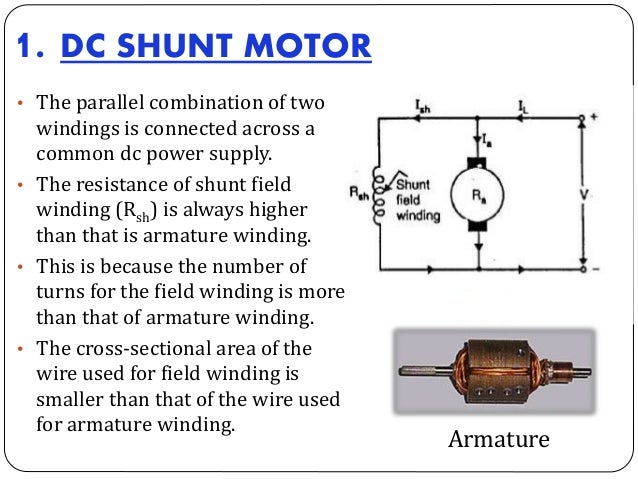
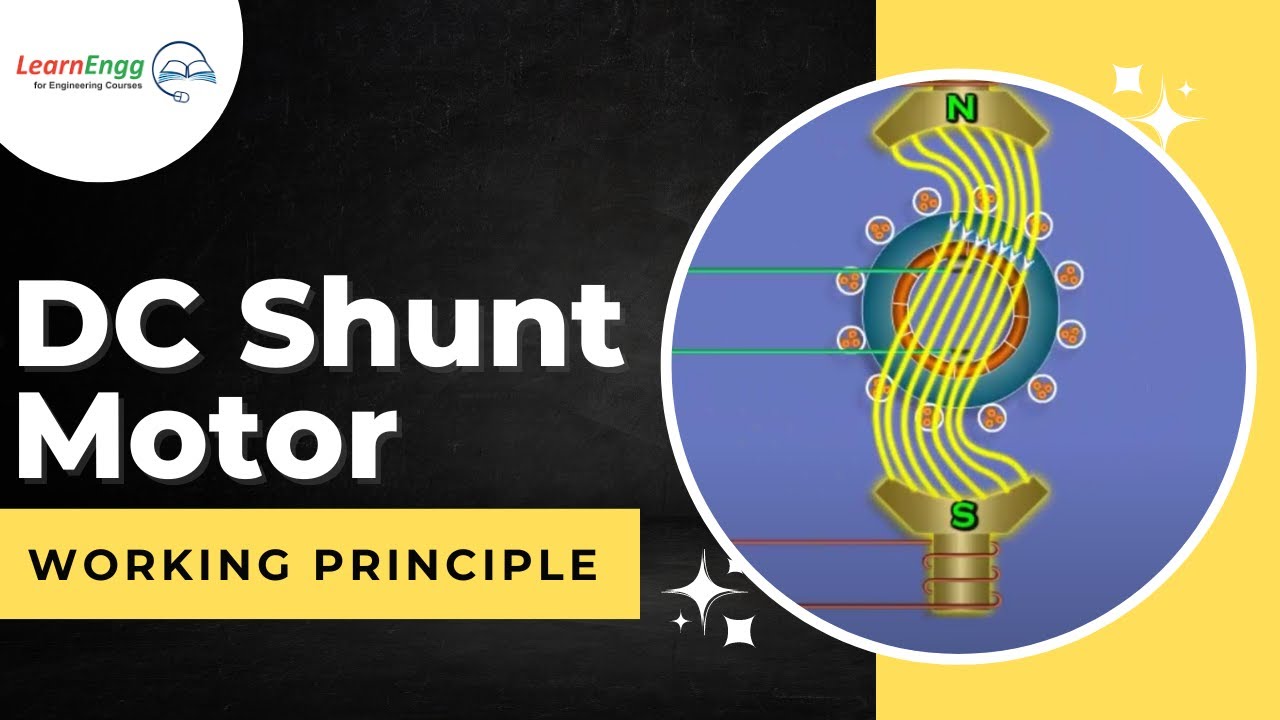
      DC shunt motor

      In case of DC motors Speed ∝ Back emf(Eb)/flux(φ)
      The field winding in shunt motor is connected in parallel to the armature winding and the supply.
      If we assume that the supply voltage is constant then flux also becomes constant.
      At the rated speed the back emf also becomes nearly constant if the load is same.
      Hence the speed of the shunt motor can be assumed ALMOST constant under normal running conditions .
      The motor speed drops slowly with increasing torque value.same applies with the load current.

      Double cage induction motor

      Construction


      An induction motor with two cage rotor is used for high starting torque. The slotting arrangement for double cage induction motor is as shown in above figure. As the name indicate the double cage induction motor has two winding in rotor. The outer bars consists of rotor bars having low reactance and high resistance. On the other hand, the inner cage consists of rotor bars having high reactance and low resistance.

      Working

      At start the rotor frequency is high, the outer cage carries most of the current despite its high resistance. The inner cage has low reactance and is mostly ineffective. This gives high starting torque and low starting current. As the motor picks up the speed, the rotor frequency reduces and the inner cage carries most of the current. Under normal running condition, the outer cage and inner cage are in parallel giving low combined resistance and both the cages are active.
      When the speed is normal frequency reduces and it is so small that the reactance of both the cages are practically negligible. Hence it has been made possible to construct a single machine which has high starting torque with reasonable starting current which maintains speed regulation and high efficiency.

      Torque-Speed characteristics

      Advantages

      1. It has high efficiency and good speed regulation.
      2. It gives higher starting torque.
      3. Lower starting current and are cheaper in cost.
      4. They are more robust and are explosion proof since the risk of sparking is eliminated by the absence of slip ring and brushes.

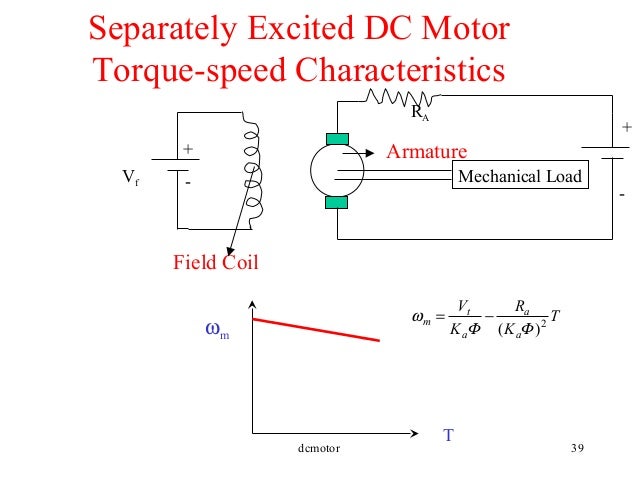
      separately excited DC motor

      The DC motor has many advantages regarding starting and speed control. Therefore, it is a key component in the educational content in all specialties of mechanical engineering, such as vehicle engineering, mechatronics engineering, mechanical design, manufacture and automation. The control technology for the DC motor is very mature and many textbooks and other published literature have discussed its fundamentals, control methods and applications. There are some DC motor software simulation models that can be used directly to design and analyse DC motor applications. The models make excellent material for education. Computer simulation is a powerful tool for education about the characteristics of DC motors. Software packages that can be used for DC motor research and education include MATLAB . Direct current motors can be divided into separately excited DC motors, shunt-wound DC motors, series-wound DC motors and compound-wound DC motors. The separately excited DC motor is typical and always taught at universities. Described in this article is the simulation of a separately excited DC motor, including starting, speed control and braking, as well as an analysis of the results.
      A MODEL OF THE SEPARATELY EXCITED DC MOTOR
      The equivalent circuit of the separately excited DC motor. Ia and If are the armature and field currents, Ra and La are the armature resistance and inductance, Rf and Lf are the field resistance and inductance, U and Uf are armature and field voltages, n and ω are the speed in r/min and rad/s, respectively, E is the back EMF (electromotive force) and Te is the electromagnetic torque.
      SIMULATION OF STARTING THE MOTOR
      At the beginning of starting the motor, the speedω = 0 and the back-EMF E = 0 . If the full voltage is applied to the armature terminals, the armature current Ia will be excessively heavy.The armature current is very heavy until the rotor runs up to full speed.
      SIMULATION OF THE SPEED REGULATION
      Three factors on the right side can be adjusted to control the speed, producing three basic speed regulation methods. A first involves adjustment of the applied terminal voltage, called armature voltage control. A second is field flux control. A third method involves the use of an external resistor connected in the armature circuit, called armature resistance control.
      SIMULATION OF BRAKING
      There are three braking methods: regenerative braking, plugging or reverse current braking, and dynamic braking or rheostatic braking. If the speed exceeds the no-load value, regenerative braking works. In rheostatic braking, an external resistance is connected in the armature in place of the DC supply. Plugging or reverse current braking is by reversing the power lines.